
Common Tree Pests in Pennsylvania
Quick Answer
If your trees have D-shaped exit holes, thinning canopy, or unusual insect activity, they may be under attack from one of Pennsylvania's most damaging tree pests. Emerald ash borer, spotted lanternfly, and scale insects are the three biggest threats to trees in our region right now, and catching them early is the difference between a treatable problem and a tree you have to remove.
Most homeowners don't think much about their trees until something looks wrong: a branch that won't leaf out, sticky residue on the patio furniture, or bark that's started to peel. By the time those symptoms show up, though, the pest causing them has often been at work for months, sometimes years.
Pennsylvania is dealing with several invasive tree pests that have reshaped how homeowners need to think about tree care. Some target specific species. Others will feed on almost anything with bark. All of them are easier to manage if you catch them before the damage is visible from the street.
Here's what to watch for, when to watch for it, and what your options are if you find something.
Emerald Ash Borer
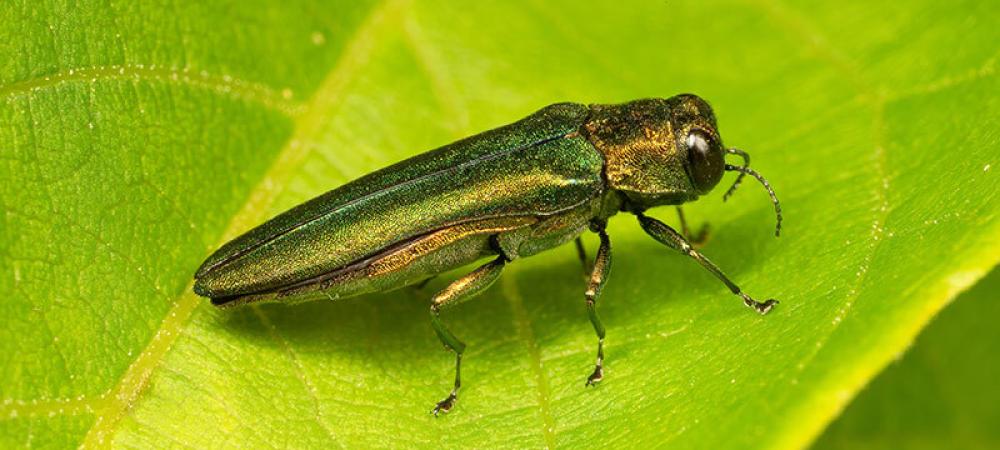
Emerald ash borer (EAB) is a small, metallic-green beetle that has killed ash trees across Pennsylvania since it was first found in the state in 2007. The beetle's larvae feed exclusively on ash trees under the bark, killing them three to five years after infestation. By 2019, it had spread to every county in the state.
New infestations are difficult to detect and may not be apparent for up to three years after the tree is first attacked. By the time you notice something's wrong, the damage below the bark is often already extensive.
Signs to watch for:
- D-shaped exit holes in the bark, about the width of a pencil eraser
- Thinning canopy or dieback starting at the top of the tree
- Vertical bark splits
- Woodpecker damage (birds go after the larvae under the bark)
- New shoots sprouting from the trunk or base of an otherwise healthy-looking tree
Adult beetles begin emerging in late May and early June, with activity peaking between mid-June and early July. If you have ash trees on your property, late spring is the time to have them inspected, before the current generation of beetles gets established.
What you can do: Preventive insecticide treatment is far more effective than trying to save a tree that's already showing heavy dieback. Once EAB has killed off a significant portion of the canopy, removal is usually the only safe option, since dead ash wood becomes brittle and hazardous.
Spotted Lanternfly
Spotted lanternflies don't bite or sting people, but they're serious trouble for trees. Large infestations can cause curling and wilting leaves, seeping sap, tree dieback, and the growth of black soot-like mold from the sticky honeydew they excrete as they feed. That honeydew also draws in ants, wasps, and other pests, and it can coat decks, play equipment, and outdoor furniture.
Signs to watch for:
- Grey, mud-like egg masses on tree bark, smooth rocks, or outdoor furniture (present through winter)
- Small black nymphs with white spots in early spring
- Adult lanternflies with distinctive spotted wings from mid-summer through fall
- Sticky honeydew residue and sooty black mold on trunks, leaves, or anything underneath the tree
- A strong preference for tree-of-heaven, though maples, black walnut, and fruit trees are also common targets
Eggs typically hatch by late April into May, and nymphs are generally more vulnerable to treatment than adults, so early-season intervention goes a lot further than waiting until you're seeing swarms of adults in July.
What you can do: Scraping and destroying egg masses over the winter helps reduce next season's population. For established infestations, systemic insecticide treatments applied to high-value trees are the most effective professional option. If you have tree-of-heaven on your property, removing it (safely, since it requires herbicide treatment to prevent regrowth) takes away the pest's preferred host.
Scale Insects
Scale insects are easy to overlook because they don't look like typical bugs. They attach themselves to bark, twigs, and leaves and stay put, which means most homeowners mistake them for a bark texture or a plant disease rather than an active infestation.
Scale insects can cause yellowing, wilting, and branch dieback, and severe infestations may require an integrated pest management approach for control.
Signs to watch for:
- Small, waxy or shell-like bumps on branches and stems that don't brush off easily
- Sticky honeydew residue similar to what lanternflies leave behind
- Yellowing leaves or branches that seem to be dying back for no obvious reason
- Sooty mold growth on and beneath affected branches
Because scale insects are slow-moving and often go unnoticed for a full season or more, ornamental trees and shrubs (think flowering dogwoods, magnolias, and hollies) are especially vulnerable to lasting damage before anyone realizes there's a problem.
When to Call a Professional
DIY treatments can help with light, early-stage issues, but a few situations call for professional evaluation:
- You're not sure whether what you're seeing is EAB, lanternfly, scale, or something else entirely
- The tree is large, near your home, or near power lines, where removal or high-reach treatment isn't a safe DIY project
- You've already lost significant canopy and want a second opinion on whether the tree can be saved
- You have multiple trees on your property and want a baseline inspection before symptoms show up
An ISA Certified Arborist can identify what's actually affecting your trees, recommend the right treatment window, and tell you honestly when treatment makes sense versus when removal is the safer, more cost-effective call.
Emerald ash borer, spotted lanternfly, and scale insects aren't going anywhere in Pennsylvania. Each one does its worst damage in the stretch before homeowners notice anything's wrong, which is exactly why a yearly inspection matters. Get it done heading into late spring, when EAB and lanternfly activity picks up, and you're catching problems while they're still cheap to fix instead of after they've spread.
If you're seeing any of the signs above, or you just want a professional set of eyes on your trees before the season gets underway, our ISA Certified Arborists can take a look and walk you through what's actually going on and what it would take to fix it. Schedule your appointment with our team today!